 English


In the field of photovoltaic (PV) module recycling, the core challenge lies in how to efficiently and environmentally separate valuable resources—such as aluminum frames, glass, silicon powder, and plastics—from end-of-life solar panels. This article provides an in-depth look at a complete PV module crushing and separation production line, guiding you through the step-by-step "transformation" of waste panels into various recyclable materials.
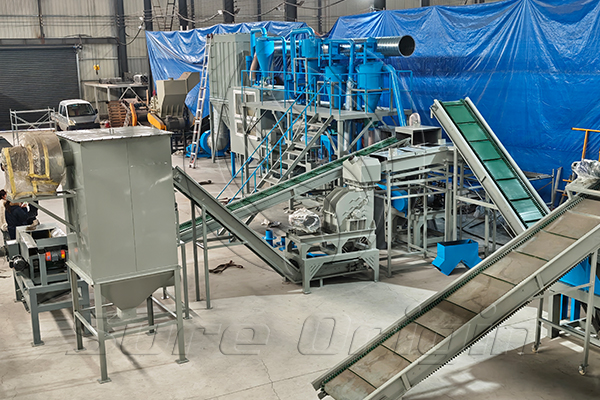
For intact, undamaged PV panels, the production line first initiates the automated dismantling unit.
1.Intelligent Feeding: The line begins with a robotic arm for automatic feeding. The robot precisely grips the whole panel and places it onto a conveyor platform, ensuring the material enters the next process smoothly.
2.Frame and Junction Box Removal: The panel is then conveyed into a frame remover. Here, the equipment automatically removes the valuable aluminum frame and the junction box. This initial physical separation step recovers high-value aluminum early on and clears the way for subsequent processing.
3.High-Temperature Glass Separation: The remaining panel body (mainly a composite of the backsheet and glass) enters a heat separator (delamination oven). Inside, high temperatures soften and decompose the EVA adhesive, allowing for the efficient separation of the backsheet from the glass. The separated glass is discharged from the bottom of the unit, while the backsheet is discharged from the top.
After high-temperature separation, the materials enter a stage of fine screening and processing.
1.Multi-Level Glass Screening: The glass fragments from the bottom of the separator are transported via a belt conveyor into a three-layer linear vibrating screen. The screens feature a graduated mesh design:
Top Layer (5mm) : Separates large glass pieces.
Middle Layer (3mm) : Collects medium-sized glass particles.
Bottom Layer (1mm) : Screens out fine glass powder.
This process yields glass products of different particle sizes, suitable for various downstream applications.
2.Backsheet Shredding: The separated backsheet, due to its large size, first passes through a dedicated slitting machine (or pre-cutter) that cuts it into small strips to fit the capacity of subsequent equipment.
3.Primary Shredding and Initial Silicon Collection: The cut backsheet pieces then enter a shredder, where they are reduced to fragments of about 4-5 cm. The shredded material is then transported via belt conveyor to a linear screen. At this stage, the screen separates out silicon powder that has been liberated during shredding. This silicon powder is collected underneath in a ton bag, achieving preliminary recovery of silicon material.
The remaining material continues into the core processing area to achieve deep liberation of metals, silicon, and plastics.
1.Secondary Crushing: The material left after the initial screening enters a crusher for secondary processing, being reduced to particles of approximately 8 mm in preparation for subsequent fine separation.
2.Rotary Screening: The crushed material then enters a rotary screen for classification. The rotary screen further separates the material by size, and at this stage, fine silicon particles liberated during crushing are collected again.
3.Grinding and Vibrating Screen Classification: After silicon collection, the material enters a grinder (mill) and is ground to a fineness of 20-30 mesh, ensuring complete liberation of any remaining silicon, plastic, and copper. The ground powder then enters a three-layer high-frequency vibrating screen for fine classification:
First Layer (Returns) : Coarse particles not meeting the size requirement are returned to the grinder for further milling.
Second Layer (Intermediate) : This fraction proceeds to the next separation stage.
Third Layer (Silicon Powder) : Collects the finest silicon powder as a final product.
After multiple stages of crushing and grinding, the material becomes a mixed powder. Finally, physical separation technologies achieve the complete separation of "silicon, plastic, and copper."
1.Air Gravity Separation: The intermediate material from the vibrating screen's second layer enters an air gravity separator. Utilizing density differences, this equipment separates the lighter mixture of plastic and silicon from the heavier copper powder, which is discharged from the front end.
2.High-Voltage Electrostatic Separation: The remaining material from the air separator (mainly a mix of silicon and plastic) then enters a high-voltage electrostatic separator. Using the principles of electrostatic adsorption, this equipment precisely separates silicon powder from plastic, resulting in high-purity silicon and plastic granules.
3.Fully Enclosed Dust Collection System: The entire production line is equipped with an integrated dust collector and a unified ductwork system. All dust generation points are connected to this system, ensuring the entire recycling process is environmentally friendly, pollution-free, and meets green production standards.
Considering that actual recycling scenarios often involve already broken PV panels, we have specifically designed a flexible dual-channel process.
When the incoming material consists of broken panels or fragments, it bypasses the front-end dismantling and delamination stages. Instead, it can be fed directly via a dedicated belt conveyor into the shredder. The subsequent process remains rigorous: first, silicon powder is collected via a linear vibrating screen; then the material is crushed to about 10mm; followed by a second silicon collection via another linear screen; and finally, an eddy current separator is used to separate the copper-aluminum mixture. The remaining backsheet material is re-screened and returned to the crusher for closed-circuit processing until it meets the grinding standard. It eventually enters the same grinding and electrostatic separation process, ensuring that no resource is left unutilized.